Evidence Anchors
Beta routes (v1.2.0); the signed anchor format is stable.
The evidence store is one hash chain: each entry carries the digest of the
entry before it, so an edited or reordered entry breaks the chain. A chain is
not a signature, though. Whoever can write the database can remove an entry
and recompute every later link, and the export still verifies. Since 1.2.0
the Network Authority signs the head of its store: a store anchor names a
store_sequence and that entry’s digest. Because each entry links to the one
before it, one anchor covers every earlier entry.
Anchors need the evidence store (EVIDENCE_STORE=on, off by default).
Without it the NA records no entries and signs no anchors, the anchor routes
answer 404 evidence_store_disabled, and NA_ANCHOR_INTERVAL_SECONDS does
nothing. The store holds only what is reported to the NA; anchors cannot
cover a change that was never recorded.
Who anchors protect against
Someone who can write the database but does not hold the NA key (a compromised host, a careless restore script, a database administrator). The NA refuses to sign a new anchor over a store that no longer continues from its last anchor (
409 evidence_anchor_refused), and its own verification (GET /admin/evidence/verify,genesis-mesh na verify-db) reports entries that no longer match their anchors.The NA’s operator, who holds the NA key, only through copies kept elsewhere. The operator can sign new anchors over a rewritten history, so anchors on the NA prove nothing against them. Anchors copied out to storage the operator cannot change do: an export that removed or rewrote anchored entries no longer matches them.
The window matters: a record can be removed without detection until the
first anchor that covers it has been copied out. Copy anchors on a schedule
you choose, asking the NA to anchor its current head each time (below); that
schedule is the window. A change made and then deleted inside the window is
caught only by a log of changes kept outside Genesis Mesh (the completeness check of
Verifying a Pack, since 1.5.0). The time to rely on is when a copy reached your storage, not
the anchored_at the NA wrote.
Keeping copies
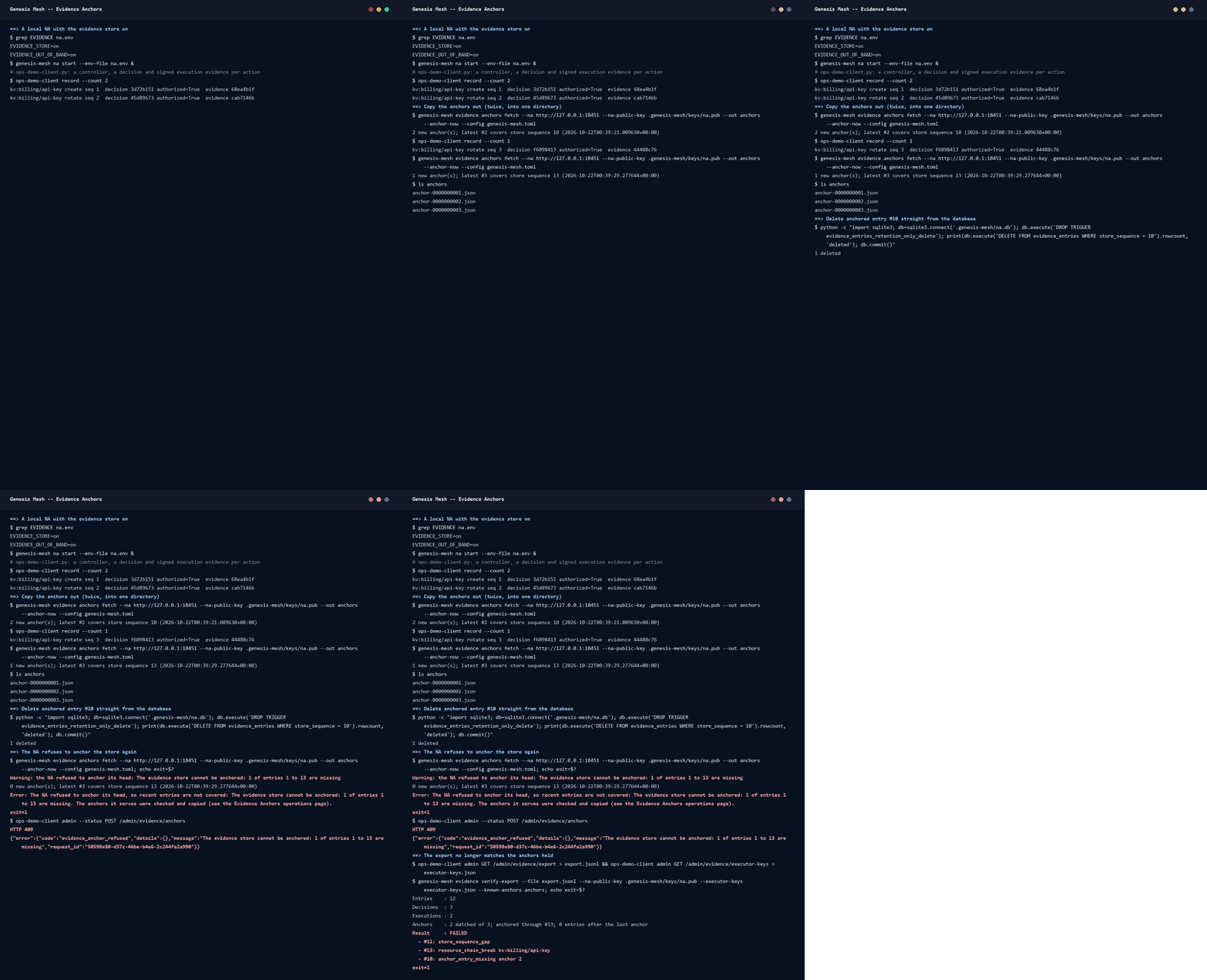
The GIF is a real run of docs/examples/assets/scripts/evidence-anchors-demo.py
against a throwaway NA with the evidence store on. It copies anchors out
twice, deletes anchored entry 10 straight from the SQLite database, and
shows what follows: the NA refuses to anchor again
(409 evidence_anchor_refused, and evidence anchors fetch --anchor-now
exits 1), and genesis-mesh evidence verify-export --known-anchors fails
with anchor_entry_missing, store_sequence_gap and
resource_chain_break. The transcript is
docs/examples/assets/images/genesis-mesh-evidence-anchors.txt.
genesis-mesh evidence anchors fetch copies anchors into a directory. Each
run reads every anchor the NA serves and compares it with the copy held: if
the NA serves a different anchor at any position you hold, or no longer serves
one, nothing is written and the command fails. Otherwise the whole set is
checked (NA signature, unbroken chain) and missing positions are written, one
file each, atomically; existing files are never replaced.
Two setups work; choose by who runs the schedule.
Pull: the auditor fetches. Give the auditing team a read-tier operator
key. From a machine the NA’s operators do not administer, run on a schedule:
genesis-mesh evidence anchors fetch \
    --na https://na.example.org \
    --na-public-key na.pub \
    --out /audit/anchors \
    --anchor-now \
    --operator-key auditor.key --operator-key-id auditor
The auditor’s schedule bounds the window, and a failed fetch is the auditor’s own alert.
Push: the operator delivers. When the auditing team prefers to provide write-once storage than to run a job, the operator runs the same command on a timer and syncs the directory into that storage: an object store with object lock (Azure Blob immutability, S3 Object Lock) or a write-once share, with a lock period at least the retention period. The auditor can see when each copy arrived but depends on the operator’s timer; a gap in arrivals is itself a finding.
Either way, alert on failure. For example with systemd:
# /etc/systemd/system/gm-anchors.service
[Unit]
Description=Copy Genesis Mesh store anchors
OnFailure=gm-alert@%n.service

[Service]
Type=oneshot
ExecStart=/usr/local/bin/genesis-mesh evidence anchors fetch --na https://na.example.org \
    --na-public-key /etc/gm/na.pub --out /srv/anchors --anchor-now \
    --operator-key /etc/gm/auditor.key --operator-key-id auditor
# /etc/systemd/system/gm-anchors.timer
[Timer]
OnCalendar=hourly
Persistent=true

[Install]
WantedBy=timers.target
Verifying an export
genesis-mesh evidence verify-export \
    --file export.jsonl \
    --na-public-key na.pub \
    --executor-keys executor-keys.json \
    --known-anchors /audit/anchors
The export must be tied to the held anchors at both ends:
its start: it starts at entry 1, or right after a retention checkpoint recorded in the export. An export of a store after retention must hold the checkpoint’s entry, which the NA appends after the entries retention kept: export through it. Anything else, while held anchors cover earlier entries, fails with
export_not_linked_to_anchors: entries before the export are not accounted for;its end: an export that stops before the newest held anchor fails with
export_ends_before_anchor.
An export since an anchored position (an incremental check of what was
recorded after the export you last verified) starts right after a held
anchor. Say so with --from-anchor (1.3.1): its first entry must then name
that anchor’s digest. Without the option such an export is not tied at its
start, because a held anchor proves the entries before it existed, not that
the store still holds them: before 1.3.1 an export of a store whose entries
through an anchored one had been deleted verified.
Inside the export, each held anchor must name its entry’s digest as received
(anchor_mismatch, anchor_entry_missing). --partial accepts a deliberate
slice and skips both end checks. The result reports linked_start,
anchored_through_sequence and unanchored_entries: entries after the newest
held anchor are covered by the hash chain only, which proves nothing against
the operator.
A retention checkpoint marks a deliberate removal and appears in the export
as its own entry; it is signed with the NA key, so treat each one as an audit
item and check it against the retention you expect. Since 1.3.1 the verifier
checks that it removed as many entries as positions
(retention_count_mismatch): from entry 1 for the first checkpoint, and from
the checkpoint before it when the export holds that one. A checkpoint signed
over a store whose entries had already been deleted fails, as far as the
export lets this be checked; the reason codes are listed in
Evidence event schema (gm.evidence.event v1).
After a restore
Restoring the NA’s database from a backup older than the newest anchor someone holds rolls the store back: new entries reuse positions the held anchors name, with different digests, and new anchors reuse anchor positions. To the holders this is exactly what removal looks like, and it is: entries recorded after the backup are gone. Treat it as an evidence-loss event:
Record the incident: when, why, the backup used, and the last
store_sequenceand anchor held before the restore.Keep the old anchor directory unchanged as the record of the lost history, and start a new directory for the restored store.
Verify the history before the restore against the old directory with an export of that range (
--partialif it is a slice). Since 1.3.1 a slice that starts after entry 1 verifies its chains from the first record it holds of each resource.
Rolling a 1.2 Network Authority back to 1.1 is a restore of this kind (see the upgrade guide).
What anchors do not prove
Anchors prove which entries the store held when each copy was made. They say nothing about changes that were never recorded.
Entries after the newest copied anchor are protected against the operator by nothing yet.
History stored before the first anchor (for example before upgrading to 1.2) is covered from the first copied anchor on, as it stood then.