Federation Bootstrap And Trust Bundle Exchange
This example shows the operator-onboarding path introduced across the v0.17.2 and v0.17.3 readiness releases. It packages another sovereign’s public trust material, validates it, records a local review receipt, and feeds the bundle into federation bootstrap without granting trust automatically.
The example uses the live Azure and DigitalOcean Network Authorities:
Role |
Sovereign |
Endpoint |
|---|---|---|
Acceptor |
|
|
Issuer |
|
|
        sequenceDiagram
    participant NB as USG-NB Trust Bundle
    participant OP as Operator CLI
    participant AZ as USG Network Authority

    OP->>NB: export public trust material
    OP->>OP: inspect bundle offline
    OP->>NB: validate bundle against live endpoint
    OP->>OP: import bundle as review evidence
    OP->>AZ: bootstrap federation with --issuer-bundle
    AZ-->>OP: dry-run treaty preview
What This Proves
A sovereign can package public trust material into one reviewable JSON file.
The receiving operator can inspect the bundle offline.
Live validation catches stale or mismatched bundle material before a treaty is issued.
trust-bundle importrecords review evidence but does not grant trust.federation bootstrap --issuer-bundleuses the bundle to seed review while still requiring explicit operator signing for real trust.
What This Does Not Prove
A trust bundle is unverified review material. Validation checks that the bundle is well-formed and internally consistent; it verifies no signatures and consults nothing outside the bundle, so a bundle authored end-to-end by one party passes every check by construction.
validation: okmeans “well-formed and self-consistent”, not “genuine”.The bundle proves nothing about who assembled it.
Never load bundle content — keys, recognition policy, treaties, or the revocation feed — into trust state. A malicious bundle could otherwise inject forged recognition relationships or a revocation feed with revocations removed.
Verify the subject’s genesis against a root key obtained independently of the bundle. The
--nalive comparison invalidateis the easiest way, and federation bootstrap already takes the partner’s key from a live query to their own endpoint rather than from the bundle.
See RFC-003 for the normative rules.
Live Recording
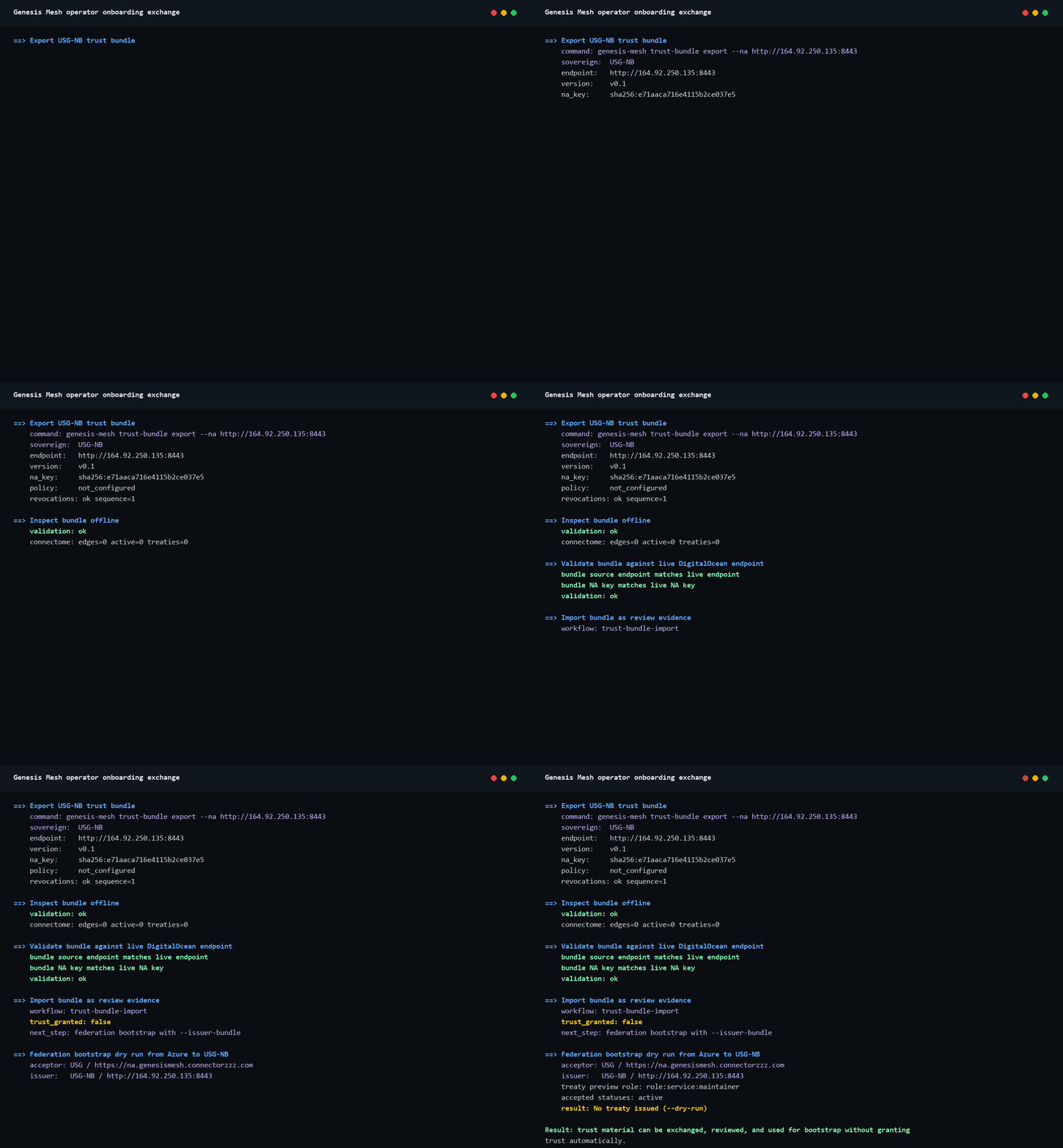
Static screenshot:
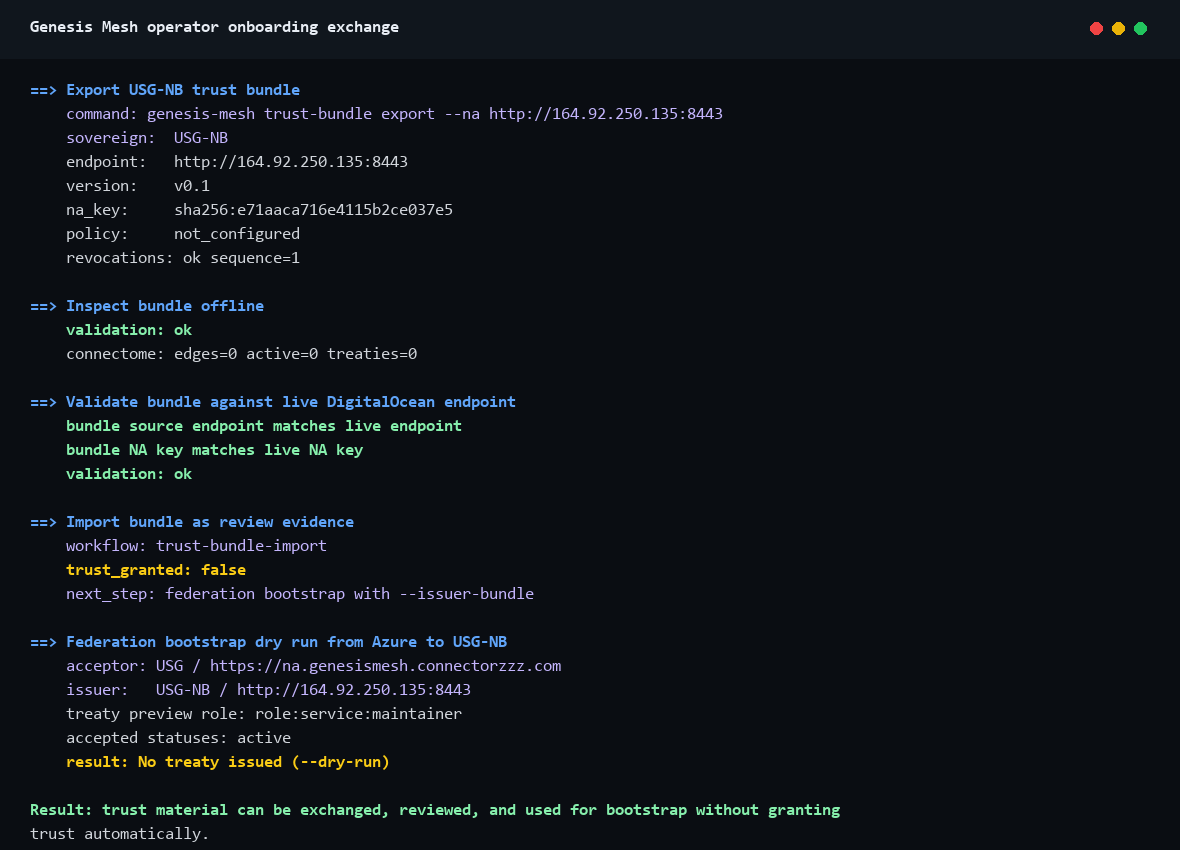
Run
Generate the documentation assets from the captured transcript:
python docs\examples\assets\scripts\operator-onboarding-exchange-demo.py
Run the non-mutating live smoke against Azure and DigitalOcean:
python docs\examples\assets\scripts\operator-onboarding-exchange-demo.py --live
Live mode runs only public export, inspect, validate, review-import, and federation dry-run steps. It does not issue a treaty.
The equivalent CLI workflow is:
$BUNDLE = "$env:TEMP\usg-nb-trust-bundle.json"
$RECEIPT = "$env:TEMP\usg-nb-trust-bundle-receipt.json"

genesis-mesh trust-bundle export `
  --na http://164.92.250.135:8443 `
  --output $BUNDLE

genesis-mesh trust-bundle inspect --bundle $BUNDLE

genesis-mesh trust-bundle validate `
  --bundle $BUNDLE `
  --na http://164.92.250.135:8443

genesis-mesh trust-bundle import `
  --bundle $BUNDLE `
  --na http://164.92.250.135:8443 `
  --output $RECEIPT

genesis-mesh federation bootstrap `
  --acceptor https://na.genesismesh.connectorzzz.com `
  --issuer-bundle $BUNDLE `
  --dry-run
To issue real trust after review, replace --dry-run with the acceptor
operator signing options and an explicit --yes.